


From Farmland to Fashion Week: Mallory Quisenberry quilts her legacy
Updated: May 16
From her rural Kentucky roots to the runways of New York, Mallory Quisenberry has stitched a career together by textile revival and personalization through her clothing brand, Green Folk Collective.
Quisenberry, who grew up on a cattle farm outside of Frankfort, Kentucky, said she credits her agricultural upbringing and family’s quilting traditions for shaping her work as a heritage-inspired designer.
Her designs have been featured at New York Fashion Week and the Kentucky Museum of Arts and Culture, marking a rapid rise from self-taught sewing to couture runways.

Quisenberry points to generations of creative women in her family as having a lasting influence on her work.
“I’m so lucky because I’ve been surrounded by the best grandmas ever,” Quisenberry said.
She describes her paternal grandmother as a style icon who wore lipstick and high heels to go pump the gas, while her maternal grandmother was the foundational matriarch for her family.
Quisenberry said her great-grandmother, who founded the Central Kentucky Homemakers Quilt Guild, was known for her bold color combinations and unique fabric choices.
“She was a very creative person who had wild tastes,” Quisenberry said.
After finding statewide success in the guild, her great-grandmother would go on to be the president of the Kentucky Heritage Quilt Society. Quisenberry said she finds similar qualities reflected in her mother, who is also very creative and hardworking.
Deciding to leave the farm and pursue higher education was an intimidating decision for Quisenberry; no one in her family had ever earned a college degree. Even so, she said she quickly found her home at the University of Kentucky, majoring in integrated strategic communications and minoring in spanish.
“After my first semester, I remember thinking, ‘Oh, I can totally do this, and I can make the Dean’s List,’” Quisenberry said.
In 2020, she said she faced new financial pressures when funding for her internship with the Kentucky Council on Postsecondary Education was cut due to the COVID-19 pandemic. From a place of desperation, she launched “Mal’s Closet Cleanout” on Instagram, selling clothes she repurposed or designed herself to support herself through college.
What began with small orders soon gained momentum with the resurgence of bleached T-shirts, allowing for a new business opportunity.
“I have a lot of memories of being in my Newtown Crossing apartment doing all kinds of designs,” Quisenberry said. “And I had a really great opportunity when Immanuel Quickly, who was playing UK basketball at the time, reached out to me.”
After Quickly’s support brought new attention to her page, Quisenberry diversified her inventory to include vintage UK merchandise and rebranded her account as “Mal Thrifts.”
Still, she said her first true breakout moment came with the “Be Nice” crewnecks — a design and message that drew thousands of new customers and followers. For months, Quisenberry handstitched these words onto 10 crewnecks a week, and while the financial success was gratifying, she said it soon pushed her to think critically about her craft.

“I remember thinking, ‘If you really want to do this, you need to have some real sewing technique and some sort of skill,’ and at that time I didn’t, really,” Quisenberry said.
The decision to slow down her business ultimately granted her the space and professional technique for Green Folk Collective to grow from viral moments into a steady brand. Stepping away from the fast-paced cycle of weekly drops, Quisenberry said she taught herself to sew through YouTube tutorials.
“I’m so glad that I learned that way,” Quisenberry said, “Because it really motivated me to make my online sewing course.”
She bought her first industrial sewing machine and spent months developing a three-week sewing course from her Louisville apartment.
“No one is going to pay me to do this, and I’m going to sell it for much cheaper than any other sewing course you can get,” Quisenberry said. “It was my way of trying to give back to something that gave so much to me.”
As her expertise and reputation grew, so did the scope of opportunities available with Green Folk Collective.
Quisenberry was invited to be a vendor at the 2023 Railbird Festival by her friend and fellow local artist, Bri Bowers. She said that has been her most successful event to date and was fundamental to her confidence as a business owner.
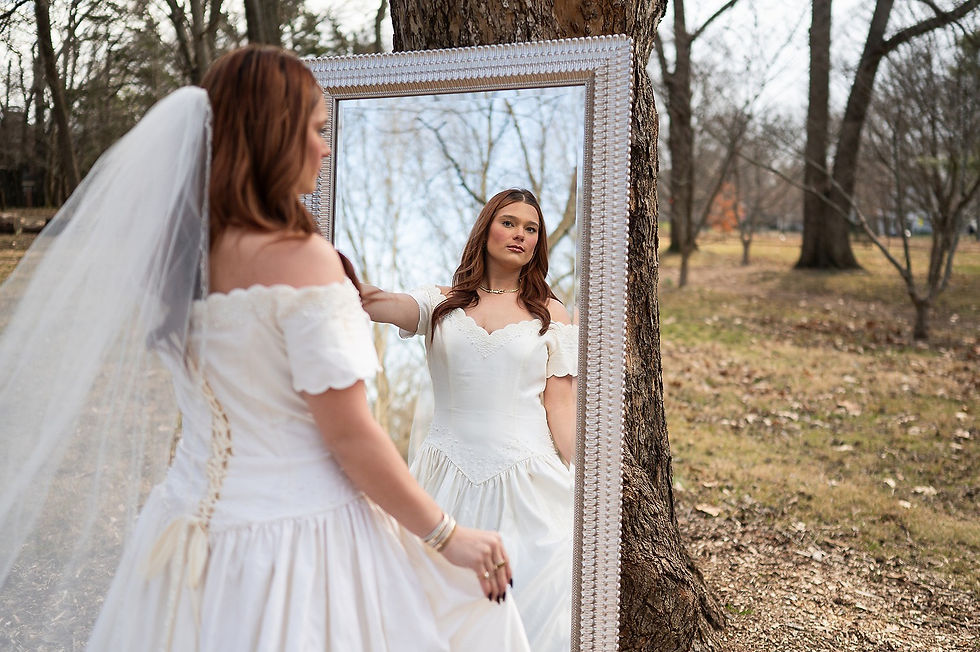
The following year, her quilt-inspired patchwork princess gown — featuring a strapless corset bodice and A-line skirt — was modeled and sold during New York Fashion Week.
“That was a dream come true,” Quisenberry said.
In 2025, her landscape dress, titled “Farming 13 Miles From Town,” was featured in the Kentucky Museum of Arts and Culture couture runway show, modeled by her childhood best friend and later displayed in the museum.
Quisenberry said quilting is not a fleeting trend but a generational practice.
“It’s a piece of my life and many people’s lives that is nostalgic. And I also really love quilts because it’s one of the few things in history that transcends all socioeconomic status,” Quisenberry said. “At the end of the day, whether you were rich or poor or in the middle, everybody had a quilt and had some sort of connection to it.”
This deep, sentimental relationship to quilts shapes her work.
“It's something that resonates with me and my family,” Quisenberry said. “It allows me to feel very connected to who I am, and I’m really grateful for that.”
Beyond the family lineage, upcycling quilts into gowns, coats or even Christmas stockings offers her something more personal.
“This is cliche,” Quisenberry said. “But it really is a meditative practice that has given me a lot of peace.”
The mission of Green Folk Collective is to breathe life into old pieces for people to enjoy.
“That is the one thing that AI can’t replicate: personal taste,” Quisenberry said.

For her, sustainability and ethical business decisions mean sourcing materials locally when she can while keeping products affordable. Quisenberry said that this duality is important both as a business owner and consumer.
“Caring about where your clothes come from is a privilege,” Quisenberry said.
Beyond fashion, she offers her wisdom on living a fulfilled life, one day at a time.
“Advice I’d give to myself: remember not just my ‘why,’ but that it’s important to make your day worthwhile,” Quisenberry said. “ … That’s where I find the most peace in my life.”
Her advice is rooted in experience, built from the small, tedious tasks like trying out a new sewing machine for the first time.
“When you’re first starting out, it (the thread) comes unthreaded or gets tangled … it would take me about 20 minutes each time (to rethread it),” Quisenberry said. “I remember thinking to myself, ‘I’m going to get so fast at it.’ And I did.”


I needed a new account name that wasn't already taken, and this name generator saved me quite a bit of time. The suggestions felt much more natural than random word combinations.
I appreciated how this piece avoided generic motivational language, offering something more specific and genuinely personal instead. The author's own experience gave the encouragement real weight rather than feeling like empty, recycled advice. That specificity is exactly what makes an inspiring blog feel meaningful rather than interchangeable with countless others. Thanks for such a specific and genuinely meaningful piece.
I found this article valuable for presenting multiple perspectives on a recent development rather than pushing a single interpretation aggressively. The author let the evidence guide the analysis rather than starting with a predetermined conclusion already firmly in mind. That fairness made the piece feel considerably more trustworthy than more one-sided coverage of similar news elsewhere. I appreciated the balanced approach to the insights offered, which respected genuine uncertainty rather than forcing false confidence. This piece delivers news and insights that feel fair rather than one-sided or agenda-driven. Thanks for such a fair and genuinely trustworthy piece.
Reading through this online blog felt less like scrolling through another generic post and more like sitting down with someone who genuinely knows what they're talking about. The depth of knowledge on display here was obvious from early on, but it never came across as intimidating or overly complex. Each section built naturally on the last, which made the whole piece easy to follow without needing to backtrack. I also appreciated the inclusion of practical examples that helped tie the more theoretical points back to something tangible. It's the kind of content that leaves you with a genuinely better understanding rather than just more information to sift through. I'll be keeping an eye on this online blog for future posts.
Google Reviews Services
Very useful article on Google review services. Positive Google reviews are crucial for local SEO, business credibility, and attracting new customers.